Basics#
Notebook showing a fast and efficient way to load Sentinel-2 L1C data into xarray
import glob
import os
import numpy as np

import pandas as pd
import geopandas as gpd
import xarray as xr

import matplotlib.pyplot as plt
import matplotlib as mpl
import cartopy.crs as ccrs
from matplotlib.colors import ListedColormap

import memory_profiler

import GRSdriver
from GRSdriver import driver_S2_SAFE as S2

%load_ext memory_profiler

opj = os.path.join

GRSdriver.__version__


'1.0.5'
Set the path of the images you want to load, here is a example for the former (v3) and current (v4) image formatting#
imageSAFE ='/data/satellite/S2/cnes/S2B_MSIL1C_20220811T100559_N0400_R022_T31NDH_20220811T171744.SAFE'
imageSAFE ='/home/harmel/Dropbox/Dropbox/satellite/S2/L1C/S2B_MSIL1C_20230711T030529_N0509_R075_T49QDB_20230711T054244.SAFE'
First, check the availbale bands:#
GRSdriver.driver_S2_SAFE.INFO
| bandId | 0 | 1 | 2 | 3 | 4 | 5 | 6 | 7 | 8 | 9 | 10 | 11 | 12 |
|---|---|---|---|---|---|---|---|---|---|---|---|---|---|
| ESA | B01 | B02 | B03 | B04 | B05 | B06 | B07 | B08 | B8A | B09 | B10 | B11 | B12 |
| EOREADER | CA | BLUE | GREEN | RED | VRE_1 | VRE_2 | VRE_3 | NIR | NARROW_NIR | WV | SWIR_CIRRUS | SWIR_1 | SWIR_2 |
| Wavelength (nm) | 443 | 490 | 560 | 665 | 705 | 740 | 783 | 842 | 865 | 945 | 1375 | 1610 | 2190 |
| Band width (nm) | 20 | 65 | 35 | 30 | 15 | 15 | 20 | 115 | 20 | 20 | 30 | 90 | 180 |
| Resolution (m) | 60 | 10 | 10 | 10 | 20 | 20 | 20 | 10 | 20 | 60 | 60 | 20 | 20 |
Choose the bands to be loaded (fill the bandIds array up) and the resolution between 10, 20 and 60 m:#
bandIds = [0,1,2,3,8,11]
resolution=60
Create the s2driver objects for the selected images#
l1c = S2.Sentinel2Driver(imageSAFE,band_idx=bandIds,resolution=resolution)
If you want to get the observation geometry bands only (i.e., sun and viewing zenith angle and relative azimuth)#
%time %memit l1c.load_geom()
peak memory: 1975.46 MiB, increment: 1511.32 MiB
CPU times: user 35.8 s, sys: 3.15 s, total: 39 s
Wall time: 7.19 s
l1c.geom
<xarray.Dataset>
Dimensions:      (wl: 6, y: 1830, x: 1830)
Coordinates:
  * x            (x) float64 4e+05 4e+05 4.001e+05 ... 5.097e+05 5.098e+05
  * y            (y) float64 2.2e+06 2.2e+06 2.2e+06 ... 2.09e+06 2.09e+06
    spatial_ref  int64 0
Dimensions without coordinates: wl
Data variables:
    vza          (wl, y, x) float32 1.91 1.913 1.915 1.918 ... 11.13 11.13 11.14
    raa          (wl, y, x) float64 127.0 127.1 127.2 ... 214.1 214.1 214.1
sza (y, x) float64 19.41 19.41 19.41 19.41 ... 18.6 18.59 18.59If you want to get the radiometric bands only (i.e., top-of-atmosphere reflectance)#
%time %memit l1c.load_bands()
peak memory: 3138.26 MiB, increment: 1731.34 MiB
CPU times: user 4min 34s, sys: 7.48 s, total: 4min 42s
Wall time: 18.2 s
/home/harmel/anaconda3/envs/grstbx/lib/python3.9/site-packages/xarray/core/indexes.py:659: RuntimeWarning: '<' not supported between instances of 'SpectralBandNames' and 'SpectralBandNames', sort order is undefined for incomparable objects.
  new_pd_index = pd_indexes[0].append(pd_indexes[1:])
If you prefer to get the geometry and radiometric bands simultaneously#
%time %memit l1c.load_product()
peak memory: 3480.60 MiB, increment: 1249.14 MiB
CPU times: user 33.4 s, sys: 8.02 s, total: 41.4 s
Wall time: 9.73 s
/home/harmel/anaconda3/envs/grstbx/lib/python3.9/site-packages/xarray/core/indexes.py:659: RuntimeWarning: '<' not supported between instances of 'SpectralBandNames' and 'SpectralBandNames', sort order is undefined for incomparable objects.
  new_pd_index = pd_indexes[0].append(pd_indexes[1:])
l1c.prod
<xarray.Dataset>
Dimensions:      (x: 1830, y: 1830, wl: 6, wl_hr: 1950)
Coordinates:
  * x            (x) float64 4e+05 4e+05 4.001e+05 ... 5.097e+05 5.097e+05
  * y            (y) float64 2.2e+06 2.2e+06 2.2e+06 ... 2.09e+06 2.09e+06
    spatial_ref  int64 0
  * wl           (wl) object 443 490 560 665 865 1610
  * wl_hr        (wl_hr) int64 400 401 402 403 404 ... 2345 2346 2347 2348 2349
    time         datetime64[ns] 2023-07-11T03:05:29
Data variables:
    bands        (wl, y, x) float32 0.1285 0.1282 0.1277 ... 0.1071 0.1084
    SRF          (wl, wl_hr) float64 nan nan nan nan nan ... nan nan nan nan nan
    wl_true      (wl) float64 442.2 492.4 558.9 664.9 864.0 1.61e+03
    vza          (wl, y, x) float32 1.91 1.913 1.915 1.918 ... 11.13 11.13 11.14
    raa          (wl, y, x) float64 127.0 127.1 127.2 ... 214.1 214.1 214.1
    sza          (y, x) float64 19.41 19.41 19.41 19.41 ... 18.6 18.59 18.59
Attributes: (12/50)
    long_name:                           CA BLUE GREEN RED NARROW_NIR SWIR_1
    constellation:                       Sentinel-2
    constellation_id:                    S2
    product_path:                        /home/harmel/Dropbox/Dropbox/satelli...
    product_name:                        S2B_MSIL1C_20230711T030529_N0509_R07...
    product_filename:                    S2B_MSIL1C_20230711T030529_N0509_R07...
    ...                                  ...
    satellite:                           S2B
    tile:                                49QDB
    solar_irradiance:                    [1874.3  1959.75 1824.93 1512.79 142...
    solar_irradiance_unit:               W/m²/µm
    mean_solar_azimuth:                  78.17671720226842
mean_solar_zenith_angle: 18.99610415879017From that stage you can check some metadata such as crs or spectral response functions:#
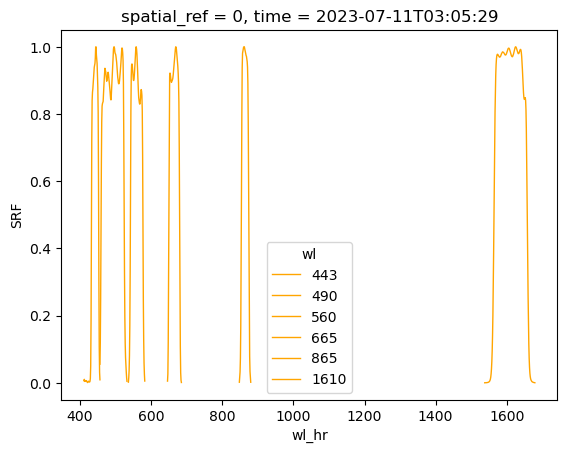
print(l1c.prod.rio.crs)
l1c.prod.SRF.plot(x='wl_hr',hue='wl',color='orange',lw=1)
EPSG:32649
[<matplotlib.lines.Line2D at 0x7f3fd0a06160>,
 <matplotlib.lines.Line2D at 0x7f3fd0a063a0>,
 <matplotlib.lines.Line2D at 0x7f3fd0a06490>,
 <matplotlib.lines.Line2D at 0x7f3fd0a06520>,
 <matplotlib.lines.Line2D at 0x7f3fd0a065e0>,
 <matplotlib.lines.Line2D at 0x7f3fd0a066d0>]
Plotting section#
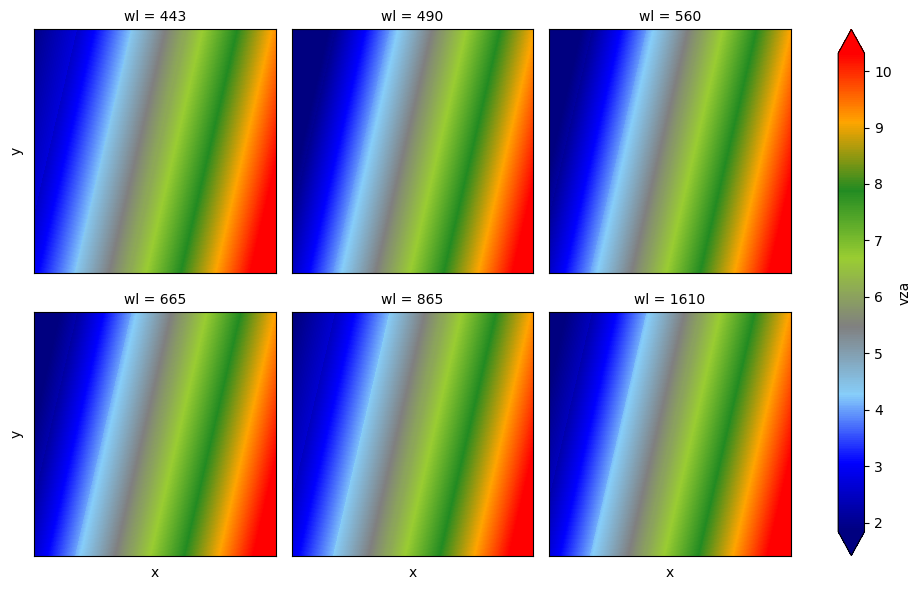
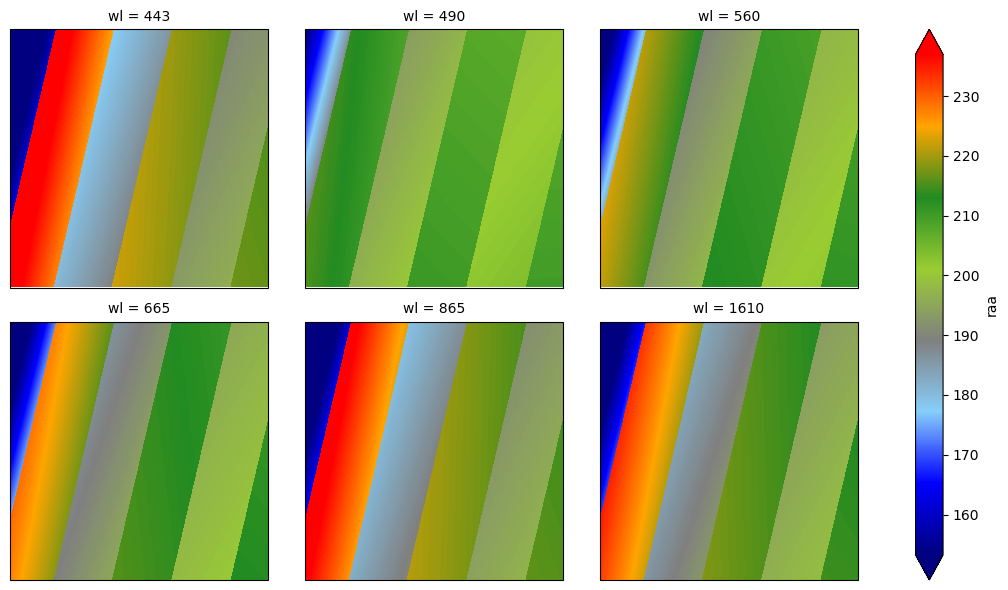
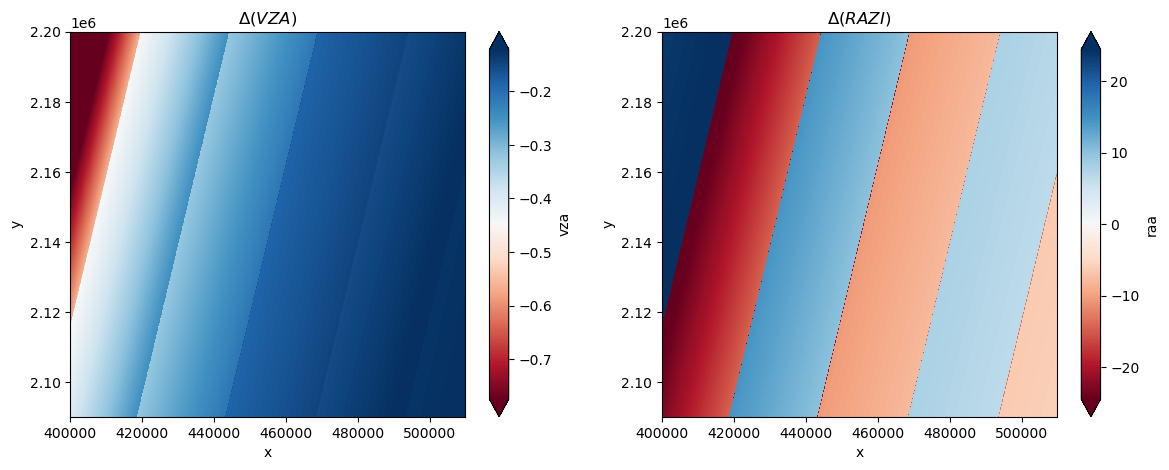
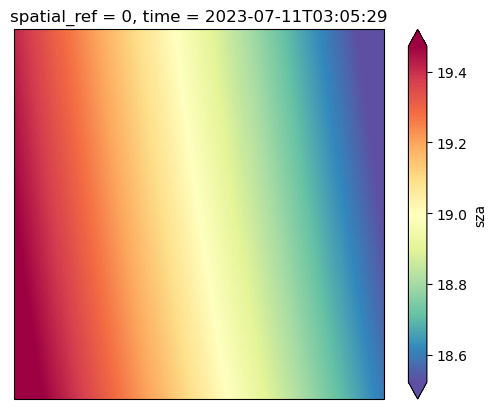
The MSI-Sentinel-2 instrument is composed of 12 detectors staggered in two different rows making a “switch” in viewng geometries along the image especially for the azimuth values. Here, we plot the solar and viewing zenith angles as well as the relative azimuth between Sun and sensor directions. The sun viewing angle (SZA) is common to all the spectral bands.
The sensor angles are dependent on the spectral band considered, here are the viewing zenith angle (VZA) and the relative azimuth (RAZI) for the bands loaded in the S2 object.
VZA#
cmap = mpl.colors.LinearSegmentedColormap.from_list("",['navy', "blue", 'lightskyblue', 'gray', 'yellowgreen', 'forestgreen', 'orange', 'red'])
fig = l1c.prod.vza.plot.imshow(col='wl', cmap=cmap, col_wrap=3,  robust=True,subplot_kws=dict(xlabel='',xticks=[], yticks=[]))
RAZI#
import cartopy.crs as ccrs
str_epsg = str(l1c.prod.bands.rio.crs)
zone = str_epsg[-2:]
is_south = str_epsg[2] == 7
proj = ccrs.UTM(zone, is_south)
fig = l1c.prod.raa.plot.imshow(col='wl', cmap=cmap, col_wrap=3, aspect=1.2, robust=True,subplot_kws=dict(projection=proj))
Check the difference between two bands (e.g., B02-B8A)
param='vza'
diff_vza = l1c.prod[param].sel(wl=490)-l1c.prod[param].sel(wl=865)
param='raa'
diff_raa = l1c.prod[param].sel(wl=490)-l1c.prod[param].sel(wl=865)
fig, axs = plt.subplots(ncols=2,figsize=(14,5))
diff_vza.plot.imshow(ax=axs[0],cmap=plt.cm.RdBu, robust=True)
axs[0].set_title('$\Delta (VZA)$')
diff_raa.plot.imshow(ax=axs[1],cmap=plt.cm.RdBu, robust=True)
axs[1].set_title('$\Delta (RAZI)$')
plt.show()
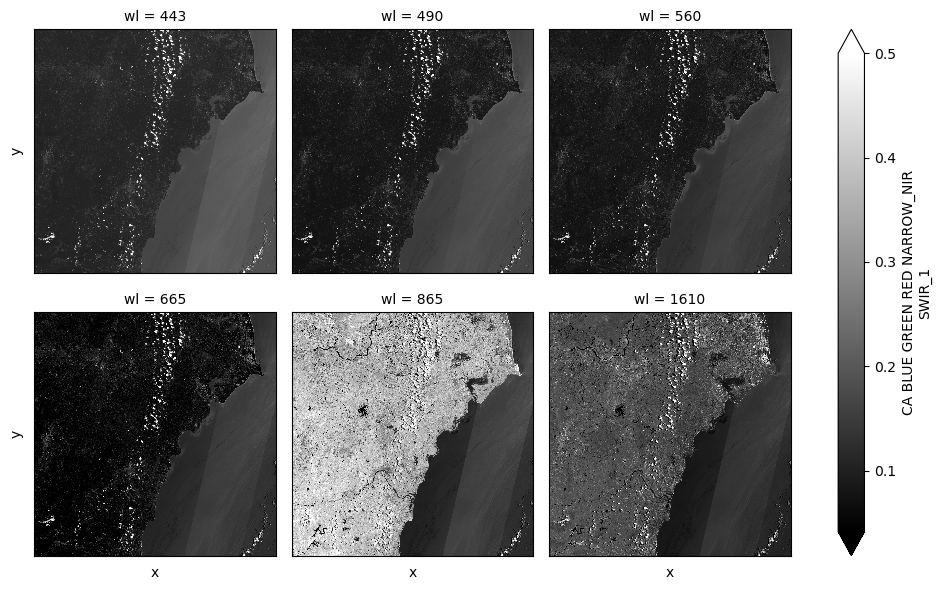
The reflectance data can also be easily plotted:
p = l1c.prod.bands.plot.imshow(col='wl', col_wrap=3, vmax=0.5, robust=True, cmap=plt.cm.binary_r,subplot_kws=dict(xlabel='',xticks=[], yticks=[]))
For nicer plotting we use cartopy and argument ‘projection’ of matplotlib
import cartopy.crs as ccrs
str_epsg = str(l1c.epsg)
zone = str_epsg[-2:]
is_south = str_epsg[2] == 7
proj = ccrs.UTM(zone, is_south)
coarsening = 10
p = l1c.prod.sza[::coarsening, ::coarsening].plot.imshow(subplot_kws=dict(projection= proj), robust=True, cmap=plt.cm.Spectral_r)
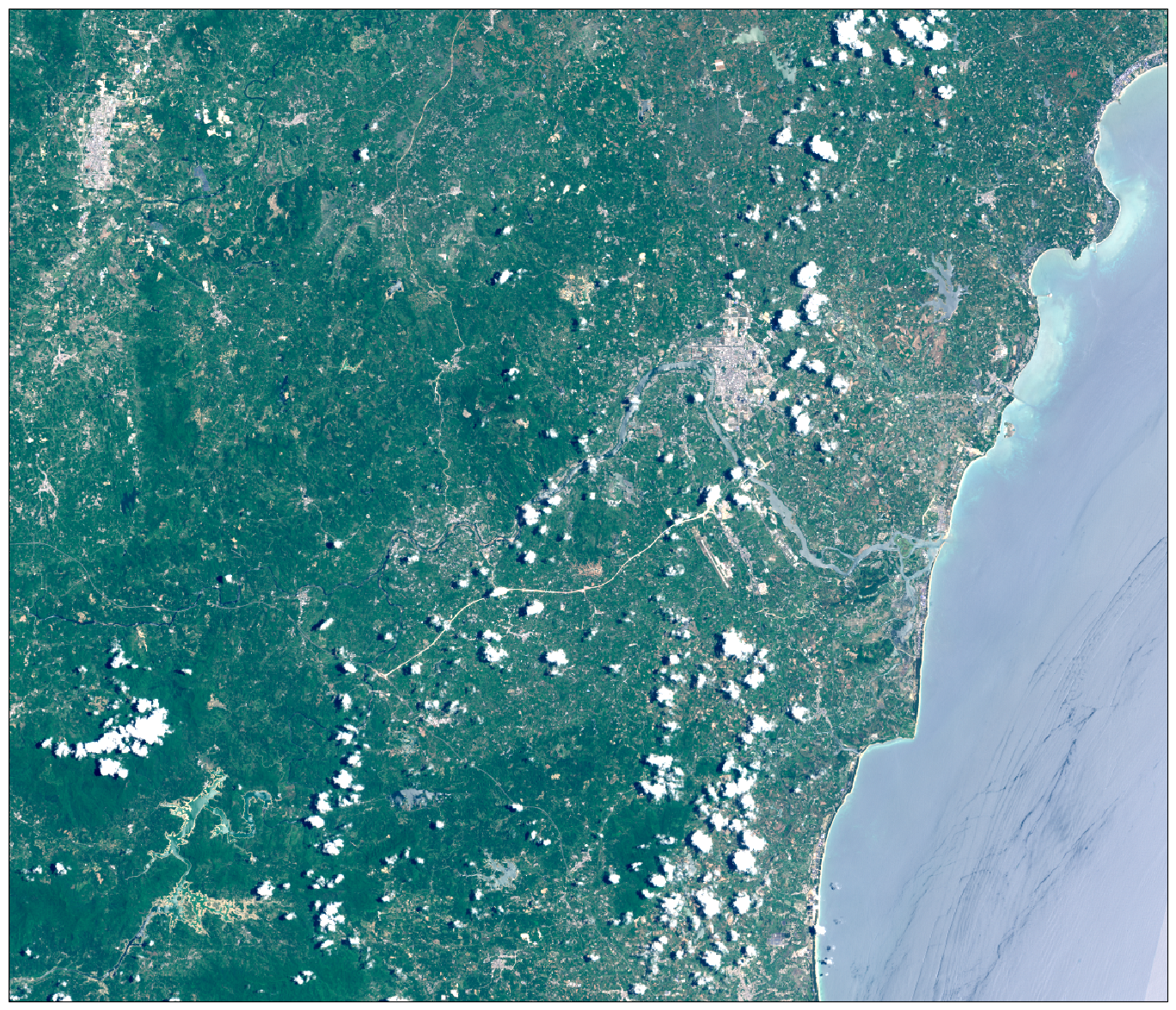
And the RGB image:
# Get geographic projection and bounds
extent = l1c.extent

bounds = extent.bounds
extent_val = [bounds.minx[0], bounds.maxx[0]-40000, bounds.miny[0], bounds.maxy[0]-50000]
#extent_val = [bounds.minx[0], bounds.maxx[0], bounds.miny[0], bounds.maxy[0]]
fig = plt.figure(figsize=(20, 15))
ax = plt.subplot(1, 1, 1, projection=proj)
ax.set_extent(extent_val, proj)
coarsening=1
brightness_factor = 3.5
(l1c.prod.bands[:, ::coarsening, ::coarsening].sel(wl=[665,560,490])**0.5**brightness_factor
).plot.imshow(rgb='wl', robust=True,subplot_kws=dict(projection= proj))
ax.set_title('')
Text(0.5, 1.0, '')
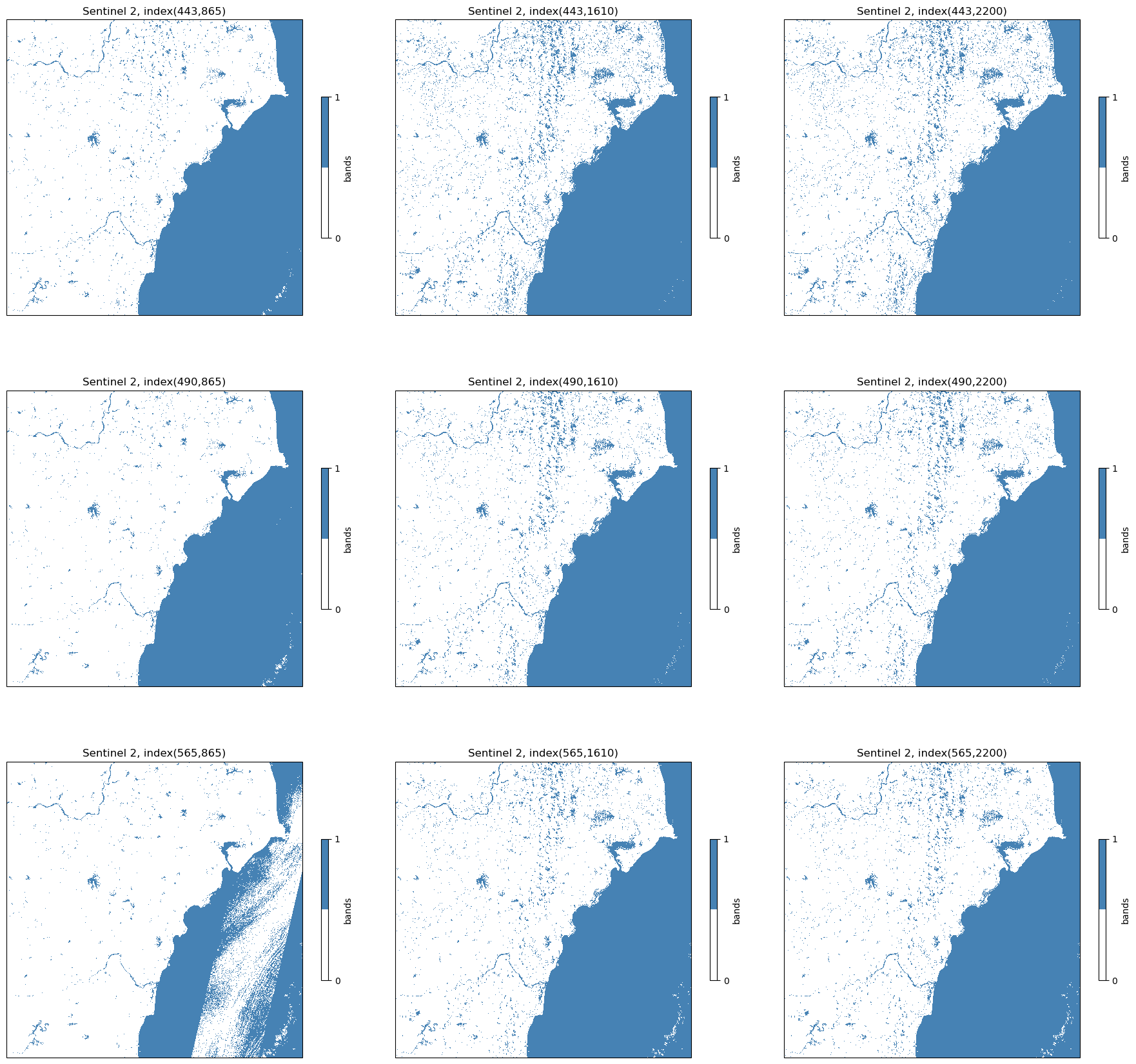
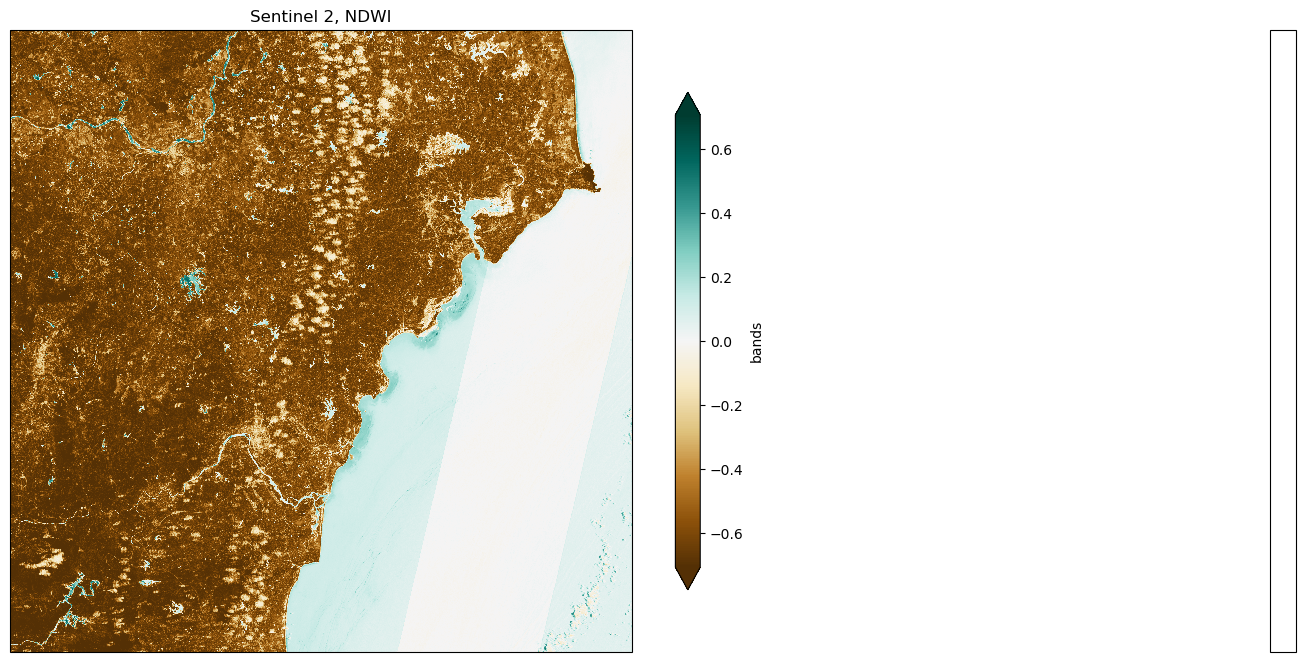
Example of exploiation: compute NDWI for water pixel masking#
#coarsening to save memory and speed (if greater than 1)
coarsening=1


# binary cmap
bcmap = mpl.colors.ListedColormap([(0,0,0,0),'steelblue'])

def sindex(R1,R2):
    return (R1-R2)/(R1+R2)

def water_mask(ndwi, threshold=0):
    water = xr.where(ndwi > threshold, 1, 0)
    return water.where(~np.isnan(ndwi))

def plot_water_mask(ndwi,ax,threshold=0):
    water = water_mask(ndwi, threshold)

    water.plot.imshow(ax=ax, transform=proj, cmap=bcmap,
                                  cbar_kwargs={'ticks': [0, 1], 'shrink': shrink})
    ax.set_title(str(threshold)+' < NDWI')
# Compute NDWI
green = l1c.prod.bands.sel(wl=565,method='nearest')
nir = l1c.prod.bands.sel(wl=865,method='nearest')
ndwi = (green - nir) / (green + nir)

fig = plt.figure(figsize=(20, 15))
fig.subplots_adjust(bottom=0.1, top=0.95, left=0.1, right=0.99,
                    hspace=0.05, wspace=0.05)
shrink = 0.8

ax = plt.subplot(2, 2, 1, projection=proj)
fig = ndwi[::coarsening, ::coarsening].plot.imshow( transform=proj, cmap=plt.cm.BrBG, robust=True,
                                   cbar_kwargs={'shrink': shrink})
# axes.coastlines(resolution='10m',linewidth=1)
ax.set_title('Sentinel 2, NDWI')

for i,threshold in enumerate([-0.2,0.,0.2]):
    ax = plt.subplot(2, 2, i+2, projection=proj)
    plot_water_mask(ndwi_,ax,threshold=threshold)

plt.show()
---------------------------------------------------------------------------
NameError                                 Traceback (most recent call last)
Cell In[22], line 19
     17 for i,threshold in enumerate([-0.2,0.,0.2]):
     18     ax = plt.subplot(2, 2, i+2, projection=proj)
---> 19     plot_water_mask(ndwi_,ax,threshold=threshold)
     21 plt.show()

NameError: name 'ndwi_' is not defined
shrink = 0.4
ii=1
ncols=3
nrows=3
fig,axs= plt.subplots(nrows,ncols,figsize=(20, 20),sharey=True,sharex=True,subplot_kw={'projection':proj})
fig.subplots_adjust(bottom=0.1, top=0.95, left=0.1, right=0.99,
                    hspace=0.05, wspace=0.05)
axs_=axs.ravel()
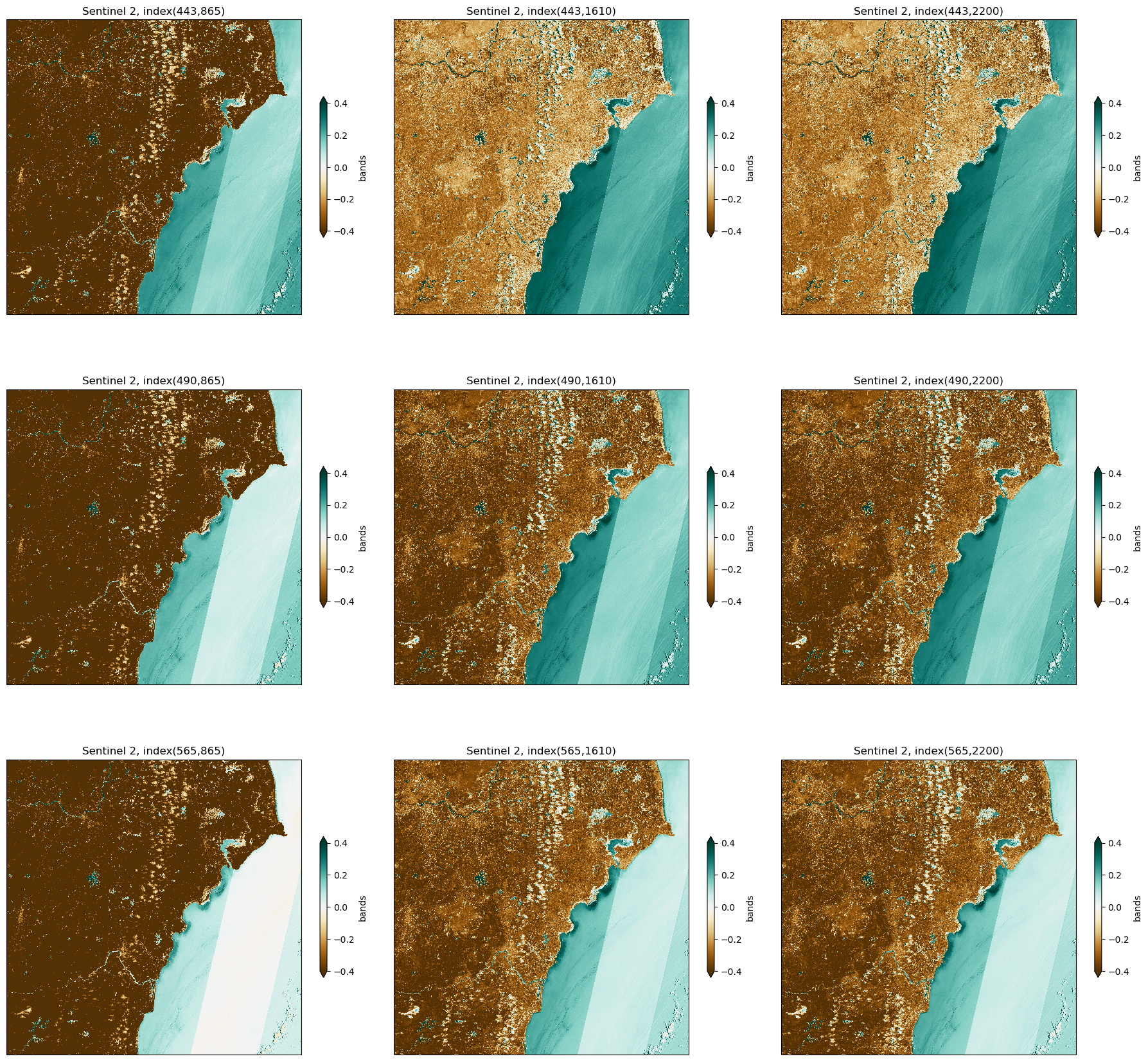
for bands in ([443,865],[443,1610],[443,2200],[490,865],[490,1610],[490,2200],[565,865],[565,1610],[565,2200]):
    #ax = plt.subplot(nrows,ncols, ii, projection=proj)

    ax=axs_[ii-1]

    fig = sindex(l1c.prod.bands.sel(wl=bands[0],method='nearest'),l1c.prod.bands.sel(wl=bands[1],method='nearest')).plot.imshow(ax=ax, transform=proj, cmap=plt.cm.BrBG, vmin=-0.4,robust=True,
                                       cbar_kwargs={'shrink': shrink})
    ax.set_title('Sentinel 2, index({:.0f},{:.0f})'.format(*bands))
    ii+=1
threshold=0
shrink = 0.4
ii=1
ncols=3
nrows=3
fig,axs= plt.subplots(nrows,ncols,figsize=(20, 20),sharey=True,sharex=True,subplot_kw={'projection':proj})
fig.subplots_adjust(bottom=0.1, top=0.95, left=0.1, right=0.99,
                    hspace=0.05, wspace=0.05)
axs_=axs.ravel()
for bands in ([443,865],[443,1610],[443,2200],[490,865],[490,1610],[490,2200],[565,865],[565,1610],[565,2200]):
    #ax = plt.subplot(nrows,ncols, ii, projection=proj)

    ax=axs_[ii-1]

    norm_index = sindex(l1c.prod.bands.sel(wl=bands[0],method='nearest'),l1c.prod.bands.sel(wl=bands[1],method='nearest'))
    plot_water_mask(norm_index,ax,threshold=threshold)
    ax.set_title('Sentinel 2, index({:.0f},{:.0f})'.format(*bands))
    ii+=1